You’re Not Doing It Wrong — Parenting a Child with Anxiety or ADHD Is Just That Hard.

When your child’s anxiety or ADHD is running your household, I help you understand what’s really happening — and what to actually do about it.

You love your child deeply. You’ve read the books, watched the videos, tried the advice. But some mornings still end in tears — yours and theirs. The meltdowns keep coming. The school refusal. The homework battles. The constant need to manage every detail of their world just to keep the peace.

If your child struggles with anxiety, ADHD, or behavior you can’t quite make sense of, parenting can feel like navigating a maze without a map. What works for other kids doesn’t work for yours. What worked yesterday doesn’t work today.

You don’t need another parenting book. You need someone who truly understands what anxiety and ADHD look like from the inside — and who can help you become the parent your child needs you to be.

SCHEDULE A FREE CONSULTATION
A mother and teenage son having a calm, connected conversation at home

Does Any of This Sound Familiar?

This coaching is for parents who:


Have a child whose anxiety shows up as tantrums, refusal, perfectionism, or meltdowns — and you’re not sure how to respond

Suspect or know your child has ADHD, and you’re struggling with the impulsivity, emotional intensity, or focus issues

Walk on eggshells trying to prevent the next explosion — and feel like you’re failing

Give in to your child’s demands or meltdowns just to get through the day — and feel guilty about it

Have tried everything and nothing seems to stick

Are overwhelmed, exhausted, and honestly — a little triggered by your own child

Worry that your child’s anxiety or ADHD is getting worse, not better

Just want your home to feel calmer, and your relationship with your child to feel stronger

If you checked even a few of these, you’re in the right place.

I work with parents of children from toddlers through young adults. Whether your child is 4 or 17 — or even a college student who is struggling to launch — if anxiety or ADHD is part of the picture, I can help.

ABOUT ME

Anxiety Doesn’t Always Look Like Worry

Here’s something most parents don’t know: anxiety is a trickster. It doesn’t always look like a nervous, weepy child. Anxiety can show up as tantrums, defiance, refusal to go to school, perfectionism, controlling behavior, constant arguing, or a child who absolutely cannot handle transitions. It can even look like rage.

I’ve sat with parents who were completely blindsided to learn that what looked like an anger problem was actually undiagnosed social anxiety — a child so terrified of being embarrassed or criticized that when a classmate said the wrong thing, his brain went straight into fight-or-flight. What the school saw was a discipline problem. What was actually happening was a child drowning in anxiety with no tools to manage it.

Child sitting quietly at home — anxiety in children can look like withdrawal, not just worry

When the Brain Goes Offline

When an anxious child “flips their lid” — when their emotional brain takes over and their rational thinking goes offline — there is no reasoning with them in that moment. No amount of logic, consequences, or pleading will work. In fact, trying to teach a lesson right then doesn’t just fail — it often makes things worse.

I use Dr. Dan Siegel’s Hand Model to help parents understand exactly what’s happening neurologically. When a child is flooded with anxiety, their prefrontal cortex — the thinking, reasoning part of the brain — essentially goes offline. Their primitive brain takes over. They are in fight-or-flight. There is no biological need for rational thought in that state. Your job in that moment is not to teach. It’s to help them feel safe enough to come back online.

Avoidance Makes Anxiety Stronger

Anxious children instinctively avoid what makes them anxious. And in the short term, avoidance works — the anxiety goes away because the trigger goes away. So the child learns: if I refuse hard enough, I don’t have to face the thing that scares me. And you, as the exhausted parent, learn: if I stop pushing, the meltdown ends.

But every time avoidance “works,” the anxiety gets a little stronger. The trigger becomes a little scarier. The refusal becomes a little more entrenched. I’ve worked with parents whose child started refusing one class, then school entirely, then leaving the house — a slow progression that started with one avoided test years earlier.

What actually helps anxiety is the opposite of avoidance: gradual, supported exposure to the thing that’s causing the fear. Not throwing the child in the deep end — but gently, consistently moving them toward it, in small steps, with you beside them. This is a large part of what makes parent coaching so effective. You are the one who can do this every day. I help you know how.

Perfectionism, Control, and the “What Ifs”

Anxious children often show up as perfectionists. They want to get it right. They want you to be happy with them. They’re terrified of making mistakes — not because they’re trying to be impressive, but because their nervous system reads failure as a genuine threat. When they believe they’ve let you down, it doesn’t just feel bad. It feels dangerous.

One of the classic signs I watch for in anxious kids is what I call the “What If” spiral: What if I don’t remember what I studied? What if I get a bad grade? What if everyone finds out and laughs at me? That spiral is anxiety knocking on the door. And once you recognize it — in your child and in yourself — you can begin to interrupt it before it takes over.

Anxious children also tend to be controlling. They want things done a certain way, they struggle with transitions and surprises, and they don’t flex easily when plans change. This is not stubbornness. Anxiety craves certainty and predictability. When a child doesn’t feel either, they try to create it by controlling their environment — and the people in it. Understanding this changes everything about how you respond.

Your Anxiety Matters Too

Here’s something I tell every parent of an anxious child: the most important thing you can do for your child is get a handle on your own anxiety. Not because you caused theirs — but because anxious children are exquisitely sensitive to the energy around them. My daughter always managed her anxiety better when she felt that I was under control. If I got anxious or upset, it immediately made hers worse.

This is why my coaching focuses on you. Not because your child doesn’t need support — they do. But because you are the constant in their life. You are there for every morning, every meltdown, every moment when anxiety has taken over the room. When you change how you show up, it changes what your child has access to. That’s not a theory. I watched it happen in my own home, and I’ve watched it happen with every family I’ve worked with.

SCHEDULE A FREE CONSULTATION

The Iceberg Concept

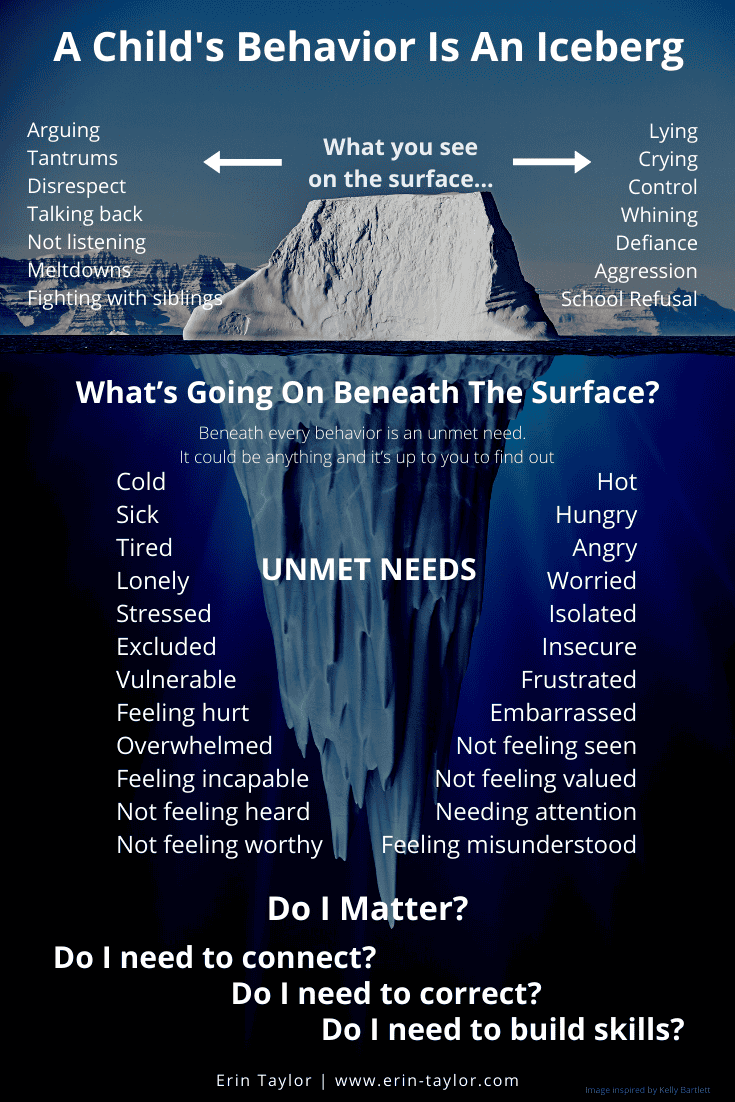
I use something I call the Iceberg with every family I work with. Your child’s behavior — the yelling, the refusing, the shutting down — is just the tip. Underneath, hidden from view, are unmet needs: feeling overwhelmed, not feeling seen, anxiety about something they can’t even name.

When you learn to read the iceberg instead of reacting to what’s on the surface, everything changes. You stop fighting the behavior and start addressing what’s underneath. Your child starts to feel understood — and feeling understood is often the first thing that begins to calm the storm.

Iceberg diagram showing that a child's visible behaviors like tantrums, defiance, and school refusal are driven by unmet needs beneath the surface including not feeling seen, heard, or worthy
Behavior is just the tip. Erin helps parents see what’s underneath — and respond to the root, not the surface.

ADHD: The Invisible Disability

I call ADHD an invisible disability. Your child isn’t in a wheelchair. There’s nothing anyone can see on the outside that signals “this kid needs extra support.” What you see is a child who can’t get off the couch to do a simple task. A child who loses their bike, forgets their homework, can’t prioritize, can’t seem to get out of their own way — and doesn’t really understand why.

And what too many parents hear — from teachers, from relatives, sometimes even from themselves — is: lazy. Doesn’t care. Making excuses. That’s not what’s happening. What’s happening is that their brain is working differently, and until the people around them understand how, nobody can actually help them.

It’s Not a Deficit — It’s a DifferenceI once heard a clinician say she wished ADHD wasn’t called Attention Deficit Hyperactivity Disorder. She wished it was called Attention Modulation Disorder. Because it’s not that kids with ADHD can’t focus — it’s that they can’t modulate their focus. They can’t turn it up or down on demand.

Put an ADHD child in front of something that genuinely interests them, and they can tune out the entire world. The smoke alarm could go off and they wouldn’t know it. They forget to eat. They don’t hear you calling them. That’s not disobedience — that’s hyperfocus, and it’s one of the most misunderstood traits of the ADHD brain.

But ask that same child to sit down and work on something they find boring? That’s when everything falls apart. And parents often interpret that gap — laser focus on Legos, complete inability to do homework — as selective compliance. It rarely is.


I call ADHD an invisible disability. He’s not in a wheelchair. There’s nothing anyone can see on the outside that signals this kid needs extra support.

ADHD Brains Are Interest-Based

Here’s something that can genuinely change how you see your child: ADHD brains are interest-based. Neurotypical brains are importance-based. Most of us can say, “I don’t want to do this, but it’s important, so I will.” An ADHD brain has real difficulty generating that motivation from importance alone.

ADHD brains are motivated by what’s interesting, what’s urgent, what’s novel, or what has a deadline bearing down. That’s why a child can spend hours deep in a video game — and can’t start a homework assignment that’s due in a week. The urgency isn’t there yet. The interest isn’t there. So, the brain doesn’t engage.

And then the night before it’s due? Suddenly they’re locked in — working for hours, skipping dinner, completely in the zone. Parents see this and think: they could have done this all along. But that’s not what happened. The brain finally had what it needed to activate. That’s ADHD, not laziness.

Task Initiation, Task Completion, and Why Homework Is So Hard

ADHD brains often struggle with two specific things: starting tasks and finishing them. The open landscape of “you have a week to do this” is genuinely paralyzing for many ADHD kids. There’s no urgency, no interest, nothing to activate the brain. So nothing happens. Days pass. Then the panic sets in.

Understanding this doesn’t mean letting the homework slide. But it does mean the solution isn’t “just make them sit down and do it.” It means helping them build external scaffolding — structured time, clear starting points, a parent nearby — while they’re young, and gradually teaching them to build their own internal scaffolding as they get older. That shift, from external support to internal self-management, is one of the most important things I help parents work toward.

Impulse Control and the Behavior Parents Can’t Explain

One of the classic signs of ADHD — one of the things clinicians actually look for — is impulse control. Does the child interrupt? Do they blurt things out? Do they do things they know aren’t okay without seeming to think first?

For younger kids, this might look like hitting a sibling for seemingly no reason. For older kids, it might look like swearing in front of parents when they know better, or making a risky decision that seems completely out of character. The ADHD brain has real difficulty modulating impulses — turning behavior on in one context and off in another. An ADHD child who swears with their friends often can’t easily flip that switch off at home, not because they don’t care, but because that self-regulation is genuinely harder for them.

When you understand this, it changes how you respond. It doesn’t mean you accept the behavior. But it means you stop interpreting it as defiance and start responding to it as a skill deficit — which is something you can actually help your child build.

When Anxiety and ADHD Look Identical

One of the most challenging things I talk about with almost every family I work with is how difficult it can be to separate anxiety from ADHD. The overlap is enormous. Anxiety can make a child have trouble focusing. ADHD can make a child anxious. School refusal can be driven by either — or both. What looks like anxiety to one parent sometimes looks like ADHD to a clinician. And they’re both looking at the same child.

I’ve sat with families who had a neuropsychological evaluation saying their child didn’t meet the criteria for ADHD — and then a different professional filled out a different screener and said it sounded very ADHD. This is not uncommon. For many children, both anxiety and ADHD are present, and addressing only one of them leaves the picture incomplete.

My coaching helps parents navigate this gray zone — not by diagnosing, but by helping you understand your specific child well enough that you can respond to what’s actually happening in front of you, regardless of what label is or isn’t attached to it.

ADHD Doesn’t Stop at Childhood

Some of the most heartbreaking conversations I have are with parents of teenagers and college students — kids who were smart enough and motivated enough to get through childhood and into a rigorous school, only to arrive there and completely fall apart. No one to wake them up. No external structure holding things together. Just a student and their own brain, and a brain that was never taught how to manage itself.

Executive function — the ability to plan, prioritize, start tasks, manage time, regulate sleep, and follow through — is exactly what ADHD disrupts. And it’s exactly what our children need to build, with our help, before we send them out into the world. That work starts now, whatever age your child is.


SCHEDULE A FREE CONSULTATION

What Makes My Approach Different

A lot of parenting advice focuses on controlling your child’s behavior. My work starts somewhere different: with you.

Not because you’re the problem. You’re not. But because you are the key. You are with your child every day — in every hard moment, every meltdown, every homework battle. When you change how you show up, it changes how your child responds. That’s not a theory. I’ve watched it happen over and over in 20+ years of doing this work.

What I love about parent coaching is that I can take concepts and help you figure out what they actually look like day to day with your child. How you actually do it. Not just what the book says, but what it looks like at 7pm when your child is melting down over homework and you’re exhausted.

Erin Taylor PCI Certified Parent Coach specializing in online coaching for adhd and anxiety

Here’s how I work:

  • You bring me the real stuff. In every session, I ask you to come with stories and scenarios from since we last met. Not hypotheticals — what actually happened in your house. That’s what we work through together.
  • We figure out what’s really going on. A big part of my work is helping you get underneath the behavior to see what’s actually driving it. What is your child telling you through what they’re doing? What unmet need is underneath the surface?
  • Then we build your response. Once we have a sense of what’s going on, we figure out how to respond differently. Different approaches work for different children — we try things, see how they land, and adjust. Parenting involves some trial and error, and I help you do that thoughtfully.
  • I flag what else might be going on. If at any point I suspect there might be something happening with your child that we haven’t yet identified — something that might warrant an OT evaluation, a speech evaluation, or a neuropsychological evaluation — I’ll tell you. You deserve the fullest picture possible.

I have lived this — not just studied it. My own daughter was diagnosed with anxiety in second grade, and later with ADHD. I navigated the medication decisions, found what actually helped, and ultimately learned how to show up for her in a way that helped her build real, lasting tools for managing her own brain. She is now a young adult who knows herself well and handles what comes her way.

I am a PCI Certified Parent Coach® with a Master’s degree in Counseling Psychology and 20+ years of experience. I work with parents one-on-one, online, from anywhere in the world.

How Coaching Works

We start with a free 30-minute consultation call — a real conversation, no pressure, no sales pitch. If I think there’s a better first step for your family, I’ll tell you.

I typically encourage parents to start with four sessions. Here’s what that looks like:

01
Deep Dive

We take the full picture — your child’s personality, history, what triggers them, what has and hasn’t worked.

02
Understanding the Root

We go underneath the behavior. I introduce the Iceberg framework and help you start reading your child’s cues differently.

03
Practical Tools

We build your personalized toolkit — how to handle hard moments without accidentally making things worse.

04
Integration & Next Steps

We review what’s working and make a plan. Some parents feel solid here; others choose to continue. We’ll figure out what’s right for you.

Unlimited Email Support

Reach out between sessions whenever something comes up. You’re not alone between calls.

Personalized Resources

Tools and materials tailored to your child’s specific challenges — not generic handouts.

Available Anywhere

All sessions are 60 minutes online. Work with me from anywhere in the US or internationally.

Ready to get off the hamster wheel?

You’ve spent enough time trying to figure this out alone. The free consultation costs you nothing except 30 minutes — and it could change everything.

Book Your Free Consultation Call

No pressure. No commitment. Just a real conversation about your child.

“When I began working with Erin, I was so stressed. Things were not going well in my family and I felt hopeless, like the vision I had for my family would never come true. But with time and Erin’s coaching, my family is now thriving, and I am becoming the parent I always wanted to be but didn’t know how.”

– Brenda G.

“Wow is all I can say! I have two beautiful girls and I used to be so stressed as a mom. I did not even enjoy parenting and felt guilty about that fact every single day. My triggers were so many that I wanted Erin on speed dial! Erin helped me to get to the root of my triggers so that I could keep them out of my interactions with my girls, and she helped me to see them, really see them as the amazing individuals they both are. Now, our days are as pleasant as our interactions and I have Erin to thank for that.”

– Hannah P.

“Erin has such a calm, peaceful demeanor. She put me at ease with every session we had together. I began to look forward to my weekly calls with her, not only because of all the wisdom she offered me, but because I felt better just talking to her.”

– Kari T.

“I went through the parent coaching process with Erin, and I appreciated her willingness to listen and focus on what was important to me. She was helpful in bringing my attention (in subtle ways, while also allowing me to discover on my own) what I really needed to know about myself in order to progress toward what I thought was important. Erin helped me to make small changes in my daily habits which improved my relationships with my family members. Erin asked the right questions, which in turn resulted in important realizations: recognizing what my priorities are as well as helping me to identify patterns and underlying causes that then spurred me to set goals for myself.

There is an enormous gap between knowing and doing. Coaching is the key to bridging that gap. I had experienced much frustration with finding a way to help myself change what I knew needed to be changed. Coaching was the catalyst, and Erin was the change agent for me.”

– Kristie C.

“Erin helped me create a calmer, more respectful home. She coached me to focus on the positive, which has improved our family relationships. I enjoyed planning with Erin how I was going to tackle the various issues that arose. I became more proactive as opposed to reactive and confrontational. Erin helped me feel capable, she encouraged me and helped me to feel like a good mom.”

– Donna M.

Frequently Asked Questions

Does my child need to be diagnosed with anxiety or ADHD for coaching to help?

Not at all. Many of the parents I work with come to me because something is clearly off — but they haven’t gotten a clear answer from doctors or teachers yet. You don’t need a diagnosis to benefit from coaching. If your child is struggling and you’re struggling too, that’s enough reason to reach out.

How is parent coaching different from therapy for my child?

Therapy works directly with your child. Parent coaching works directly with you. You’re there for every morning, every meltdown, every homework battle. When you change how you show up, it changes how your child responds. Coaching and therapy work very well together — they’re not either/or.

How do I know if we’re ready to start? My child’s challenges feel really severe right now.

The consultation call is exactly the right place to figure that out together. In some cases, coaching is the right first step. In others, I might suggest starting with a therapist and working alongside that. If I think there’s a better option for your family, I’ll tell you — I’d rather point you in the right direction than take you on as a client when something else would serve you better.

How will I know if it’s working?

There’s no specific form or score to track. I base progress on whatever particular behaviors or challenges you came in for. Sometimes we solve one issue and something new pops up. At the third or fourth session we’ll talk honestly about how things are going and whether you feel like you’re where you wanted to be. Most parents start noticing a difference within the first few sessions — not because the child changed overnight, but because they started responding differently and that created a new dynamic.

Do you work with both parents or just one?

I work with whichever parent is doing the coaching, though I encourage both parents or guardians to be involved if possible. When parents are on the same page, results are significantly stronger. That said, even if only one parent participates, the shifts that happen can still make a meaningful difference.

What does a typical session look like?

Sessions are 60 minutes over video. We review what’s come up since we last met, work through specific situations you’ve encountered, build your understanding of what’s driving your child’s behavior, and develop strategies you can use right away. You’ll leave each session with something actionable.

Do you accept insurance?

Parent coaching is not covered by health insurance — it’s distinct from therapy. I accept all major credit cards. If cost is a concern, please bring it up on our consultation call. I want this to be accessible.

My child has ADHD but isn’t especially anxious — can you still help?

Yes. While much of my work has a strong anxiety focus, the core tools I use — reading behavior through the Iceberg, responding rather than reacting, building firm and flexible boundaries, supporting emotional regulation — apply powerfully to ADHD as well. The root challenge is the same: a child whose brain works differently than the world expects, and a parent who needs a better roadmap.

Your Child Deserves a Parent Who Feels Equipped.

You Deserve Support.

You have done so much already — reading, researching, trying, adjusting, trying again. What you haven’t yet had is a guide who truly understands both the science of anxiety and ADHD and the messy, emotional reality of living with it every day.

That’s what I’m here for.

Let’s start with a conversation. The free consultation costs you nothing except 30 minutes — and it could change everything.

Book Your Free Consultation Call

No pressure. No commitment. Just a real conversation about your child.